


All About Pool Permitting In 2026
Starting a pool build is exciting. While the design and construction phases are the fun parts, there’s often an overlooked step in between: Permitting.
Permitting can sometimes feel like the most frustrating part of the process, but it plays an important role in making sure your pool is safe, code-compliant, and built correctly for your property. The good news? You’re not navigating it alone. Our in-house permitting team handles this process every day and works closely with local municipalities to keep things moving smoothly at every step.
In today’s blog post, we will highlight key code changes, walk through the documents you will need to provide our team, share estimates on how long permitting can take, and share tips to ensure a smoother permitting process.
Why Permits Matter In 2026
The state of Florida issues more residential building permits per capita than any other state, and pool permits are at the top of the list. Permitting may be an annoying process, but it is in place to ensure the work done on your home is completed correctly and safely. The newest Florida Building Code introduces stricter safety and environmental standards to ensure homes in Florida are better equipped to handle severe weather.
Failing to obtain a pool permit or ignoring a permit's plans will cause you a major headache. Hefty fines, stop-work orders, or forced demolition are all possible consequences for not permitting your pool project. No need to stress about this happening to your project when you build with Island Way Pools; our in-house permitting team will ensure your pool permit and pool build inspections go smoothly.
Florida updates its Building Code every three years. The newest version folds in lessons from recent hurricanes and safety research:
Enhanced barrier and gate specifications for all new build pools (self-latching gates, 48-inch minimum height).
Energy-efficient pump and heater requirements to lower utility costs.
Mandatory low-flow filtration systems to cut water consumption up to 30%.
Failing to incorporate these elements into your design will stall your permit application. Our design and permitting team ensures these new elements are planned for in your initial proposal.
Securing Your Pool Permit
The first step in the permitting process begins right after you sign your pool contract: our team will set you up in our CRM (BuilderTrend) so you can receive regular communication from our permitting & operations team throughout your project. Through BuilderTrend, we will communicate all your permit and project updates, keeping you up to date at every stage of your pool build.
Our in-house permitting team understands the local ordinances we need to work around and will communicate what they need from you to ensure a smooth permit application. Throughout the permitting process, we keep you updated at each key step: when your application is submitted, any time additional information is needed, and as soon as we receive responses from the municipality. Expect updates from our team through BuilderTrend, so you always know the status of your permit and what to expect next.
Timelines can range from as little as 1 week to 3 or more months, depending on your city, county, and review requirements. We know waiting isn't always easy, but this step protects your investment and helps prevent future issues. We’ll keep you informed along the way and do everything we can to minimize delays. If you ever want additional details, you’re welcome to contact our permitting staff directly.
Gathering Your Documents
What needs to be submitted for a pool permit will vary by municipality and depend on the scope of your pool project. Our permitting team will communicate which documents we need you to send over, how to send them to us, and any specific formats they need to be in. If you have trouble locating a document, just let us know, we can help you track it down. For documents that require notarization, our permitting team has a notary on staff, so you can visit our office for in-person notarization.
At a minimum, every pool permit will need:
Notice of Commencement: a document every municipality will require for construction projects that cost >$2500. This will need to be signed by you and notarized before being submitted. This lets the county know that your pool project is starting.
Pool Child Safety Acknowledgement: a document every municipality will require to be submitted as part of your pool package. This lets your county know that you understand the safety features required by Florida Law for swimming pools. This form needs to be signed and, depending on your municipality, may need to be notarized.
Surveys: a document that shows your home in relation to its property lines, utilities, setbacks, and easements. We need a scanned copy of your survey; unfortunately, photos will not work. There are two types of surveys: Boundary Surveys and Topographic Surveys. The main differences between the two are that a topographic survey costs more to get made and will show elevations on the survey. Some municipalities require a topographic survey to get your pool permit approved. Below, we will touch on what municipalities need: a topographic vs. boundary survey.
If you already have a recent survey, you may simply email us a scanned copy. If you do not have one, please let us know, and our permitting team can help get in contact with a local surveyor. A new survey will cost you $200-$1000 to have made and will take roughly 2 weeks to complete. Our team will advise you on exactly what details the survey needs to include, so you can be sure it meets municipal requirements. Below, we will discuss which municipalities need a topographic survey rather than a boundary survey. Here is a sample boundary and topographic survey for you.

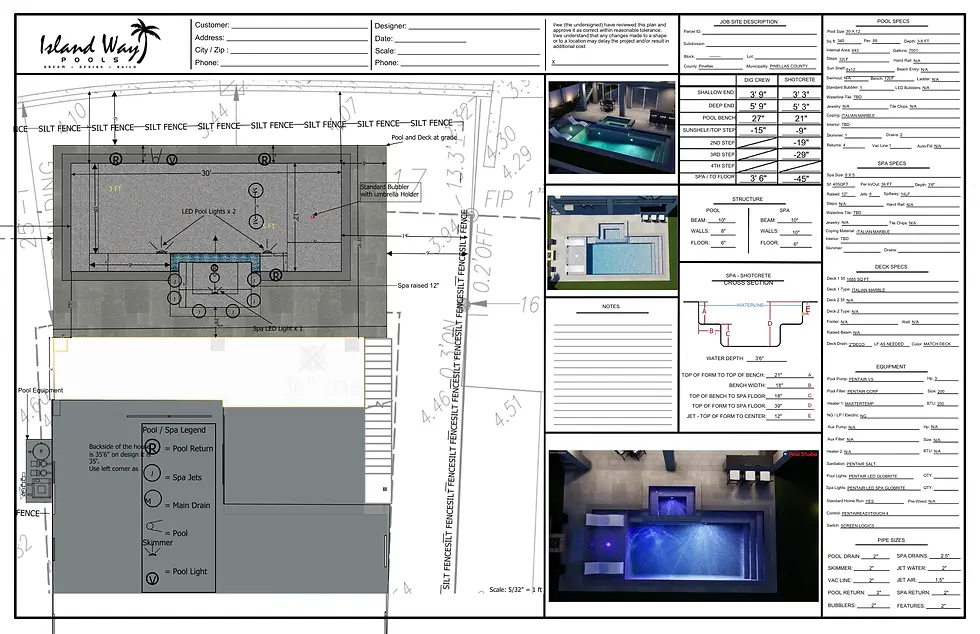
Site Plan: A site plan is a property survey that adds the new pool and patio to the 2D plans. This helps reviewers understand where the pool will be located and whether it impedes areas where a pool or patio cannot be built. Once we have a property survey, the site plan is quick for our team to put together.

Engineering Plans (Signed & Sealed): Once your pool contract is signed, our team will begin sharing your pool design and other documents with our engineer. They will assemble and sign off on a package of documents notifying the county that your pool project will comply with local building, zoning, and hurricane-resistance standards. These plans will include detailed structural, electrical, plumbing, and site-specific drawings signed and sealed by our licensed engineer.

Design Layout: Our team will use your pool design to prepare the design layout for your permit package. The design layout is a 2D, detailed plan of the project, with measurements, plumbing lines, equipment layout, and other features marked. This is all overlaid over your survey so the reviewers can see exactly where components of your pool space will be located.

Municipality-Specific Requirements & Timelines
While every permit package will require a NOC letter, a property survey, a pool child-safety acknowledgement, engineering plans, a site plan, and a design layout, some municipalities or cities may require additional documents or work to be completed. Below are some of the most common areas we service, and anything additional they may need to approve your pool permit. Not every county or municipality we work in is listed below.
Hillsborough County (differs from City of Tampa)
Requirements
Scanned Boundary Survey
Orange safety fence installation if there is no perimeter fence
Estimated Total Time: ~1–2 weeks
Clearwater
Requirements
Notarized Pool Child Safety Form
Power No-Conflict Letter (up to 10 days)
Scanned Boundary Survey
Silt fence/tree barricade installation
Estimated Total Time: ~4 weeks
St. Petersburg
Requirements
Pool Child Safety Form
Power No-Conflict Letter (up to 10 days)
Sewer Letter (5–7 days)
Scanned Boundary Survey
Same-day in-person review once all items are submitted
Estimated Total Time: ~1–2 weeks
Pinellas County
Requirements
Pool Child Safety Form
Power No-Conflict Letter (takes up to 10 days to get)
Scanned Boundary Survey dated within 5 years
Silt Fence / Tree Barricade (Habitat) Inspection
Review Time
Approximately 14 days
Estimated Total Time: ~3-4 weeks
Pasco County
Requirements
Pool Child Safety Form
Utility No Conflict Letter:
Duke (up to 10 days)
TECO (3–5 days)
Withlacoochee Electric (2 days)
Septic Tank Utility Approval Letter (in some cases)
Scanned Boundary Survey
Drainage Plan (2–3 weeks)
Topographic Survey, if not already on file
Estimated Total Time: ~3–4 weeks
City of Tampa
Requirements
Signed & sealed Topographic Survey with tree locations
Drainage Plan (4–5 weeks after budget approval)
Newly built homes require permitted home plans
Review Time
3–4 weeks
Estimated Total Time: ~3 months
Manatee County
Requirements
Pool Child Safety Form
Scanned Boundary Survey
Review Time
3 weeks for review
1 week for issuance
Estimated Total Time: ~4-6 weeks
Hernando County
Requirements
Pool Child Safety Form
Scanned Boundary Survey
Review Time
30–45 days
Estimated Total Time: ~6–8 weeks
Sarasota County
Requirements
Drainage Plan (typically 4 weeks)
Topographic Survey often required (used to create a drainage plan)
Review Time
About 4 weeks
Estimated Total Time: ~8 weeks
Inspections

Once your permit is approved, our operations team will schedule a time to meet with you at your home to discuss the upcoming steps in your pool project. This appointment is typically scheduled within 14 days of your permit's approval and will introduce you to your project manager.
Throughout the pool build, your project will undergo inspections by the county to ensure that all work being done at your home is following the approved permit plans. These inspections will be scheduled by your project manager, saving you the stress of calling and coordinating with the city. These are the inspections your pool permit will need to go through:
Excavation & Steel Inspection – Verifies setbacks and proper rebar layout before the concrete shoot.
Plumbing Inspection – Verifies the PVC runs, suction fittings, drains, and supply lines before backfilling the trenches.
Bond Wire & Footer Inspection – Checking bonding, lighting, switches, outlets, and pump connections. If a footer was installed, they will also check to ensure all rebar was installed properly.
Decking Inspection (depends on the municipality) – A decking inspection is not required in all municipalities. If it is needed, they will ensure a proper grade and installation of the patio space.
Final Inspections – Checking the water circulation system and certifying completion of the project according to the approved permitting plans.
What Can Cause Application Delays?
Incomplete permit applications are the main cause of delays in most municipalities across Florida. Missing documents, missing signatures, or additional documents required by obscure regulations are the most common reasons permits are returned for revisions.
There’s not a ton you can do to move things along once we have submitted your paperwork. The only hope of controlling the timeline comes before everything is sent for approval. If you want to receive your permit quickly, you’ll need all the necessary documents, signatures, and detailed plans ready to go. To help you stay on track, be sure to check BuilderTrend a few times a week for any new messages or document requests from our permitting team. You will also receive email notifications for any new updates, but logging in directly keeps you in the loop and allows you to respond promptly. Anything with missing info is bound to get lost in translation and eat up precious planning phase time.
To avoid permitting taking longer, immediately after you sign your contract, our permitting team will begin communicating with you and working closely to collect all required documents and signatures to ensure a successful permit application.
Start Permitting & Building With Confidence
Permitting & building your own outdoor oasis in 2026 does not need to be a stressful process. With early planning, working with an experienced team like the Island Way Pools team, and following the tips outlined above, you’ll glide through approvals and be ready to swim sooner.
As soon as you sign your pool contract, keep an eye on your email and BuilderTrend dashboard for messages from our permitting team. The first steps are simple: check for requests, gather any required documents, and respond to communications promptly. This will ensure your permit application gets moving right away.
Ready to start your pool design? Reach out to Island Way Pools to schedule your free, on-site design consultation. 727-486-0440
Sources
"2021 Residential Building Permits by State." Fixr.com, 2021. https://www.fixr.com/resources/residential-building-permits Accessed February 24, 2026
"Chapter 553 - 2025 Florida Statutes." The Florida Senate, 2025. https://www.flsenate.gov/Laws/Statutes/2025/Chapter553/All Accessed February 24, 2026
"Fla. Stat. 553.909 – Setting requirements for appliances; exceptions." https://law.justia.com/codes/florida/title-xxxiii/chapter-553/part-v/section-553-909/
"PERMITS, PLANS, INSPECTIONS." Florida Building Commission, 2026. https://www.floridabuilding.org/fbc/commission/FBC_0415/Commission_Education_POC/701/701-0-MATERIAL.pdf
"Florida Statutes Section 713.135 - Notice of Commencement and Applicability of Lien." https://www.flsenate.gov/Laws/Statutes/2023/0713.135
"Residential Swimming Pool and Spa Checklist." City of Orlando. https://www.orlando.gov/Building-Development/Permits-Inspections/Get-a-Permit/Permitting-Checklists/Residential-Swimming-Pool-and-Spa-Checklist
"Expert Verification: 5 Permit Mistakes to Avoid." All Florida Permits, 2024. https://allfloridapermits.com/5-common-permit-mistakes-and-how-to-avoid-them/
“United States - Building Permits by State.” Indexmundi.com, 2025, www.indexmundi.com/facts/united-states/quick-facts/all-states/new-building-permits-for-private-housing-units#map.
“Residential Pool Requirements.” Hcfl.gov, 2026, hcfl.gov/businesses/hillsgovhub/residential-and-mobile-home-checklists/residential-pool-requirements. Accessed 24 Feb. 2026.


Comments